Most bad hires were decided before anyone was interviewed.
Not by the candidate. By the fact that nobody ever wrote down what the job actually is. So you interview against a feeling, pick the best of the bunch, and find out in month four that the best of the bunch was not the right one.
Spend about twenty minutes answering questions about the role. You walk away with four documents that say what the job is, who it needs, and what good looks like. All four are free, and they are yours to keep.
 Watch Max · 1:39
Watch Max · 1:39
Watch Max · 1:39
A guided session, not a template you fill in.
You are not downloading a worksheet. You open it and it starts asking you about the role: what this person has to get done, what has been going wrong, what your business is actually like. You answer in plain language, the way you would answer out loud.
While you answer, it writes. Each document appears as it lands, and you change anything that is wrong.
Four finished documents, written around your role.
Not a template with your job title dropped into it. Below are real pages from a real session, cut short on purpose.
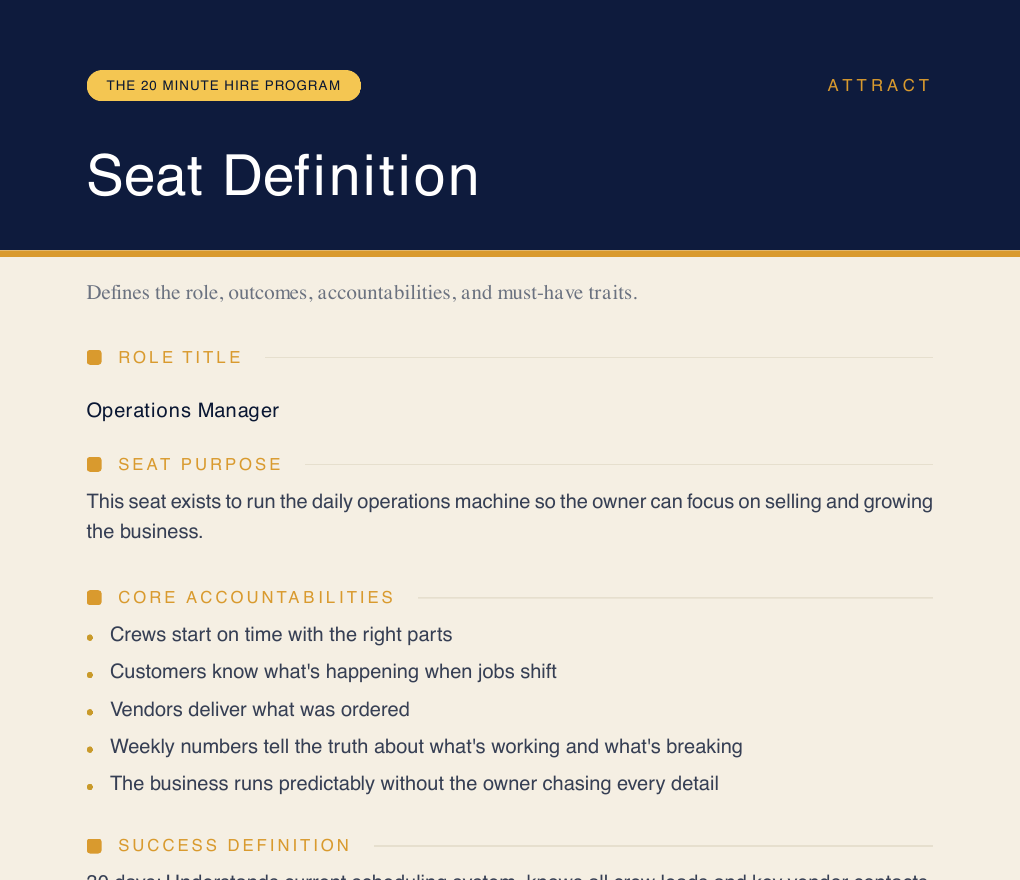
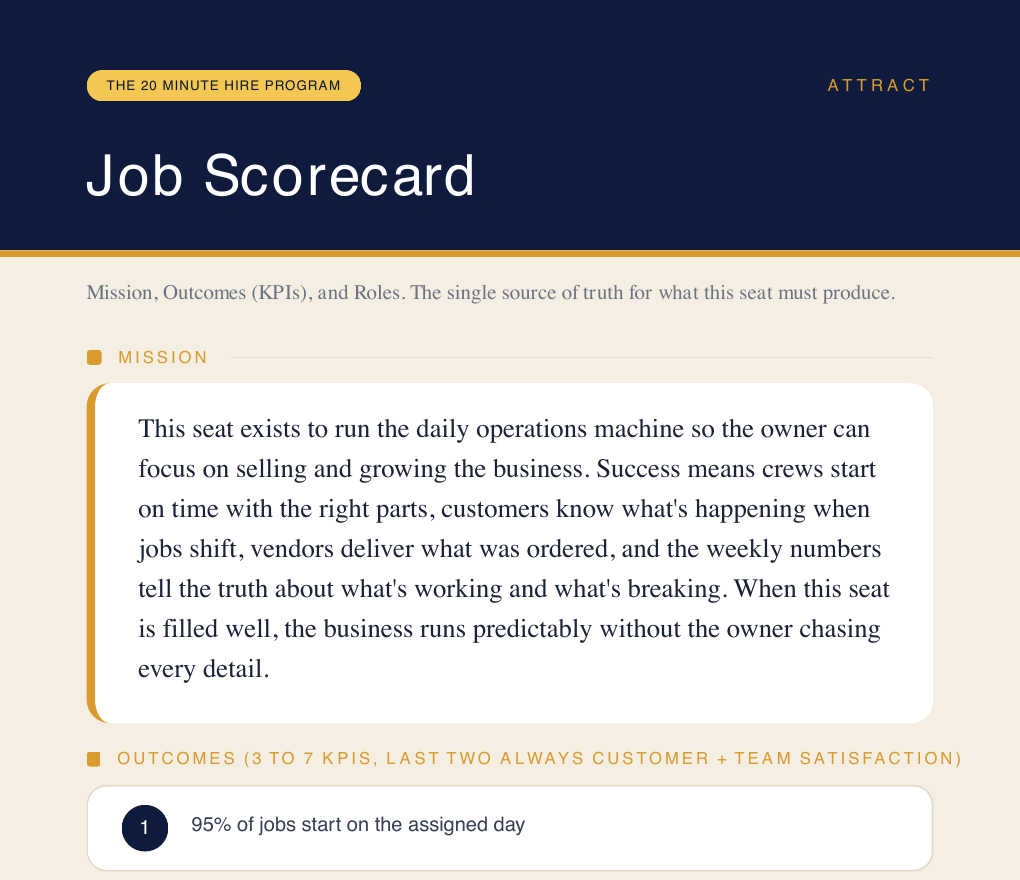
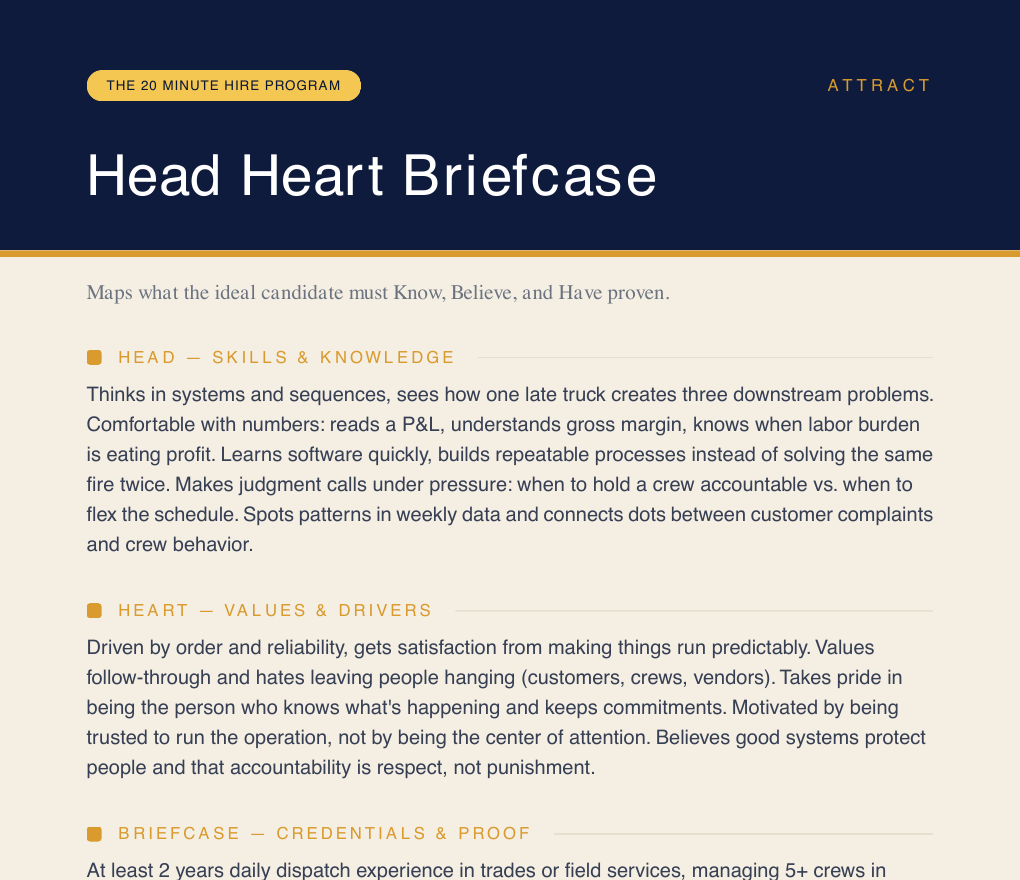
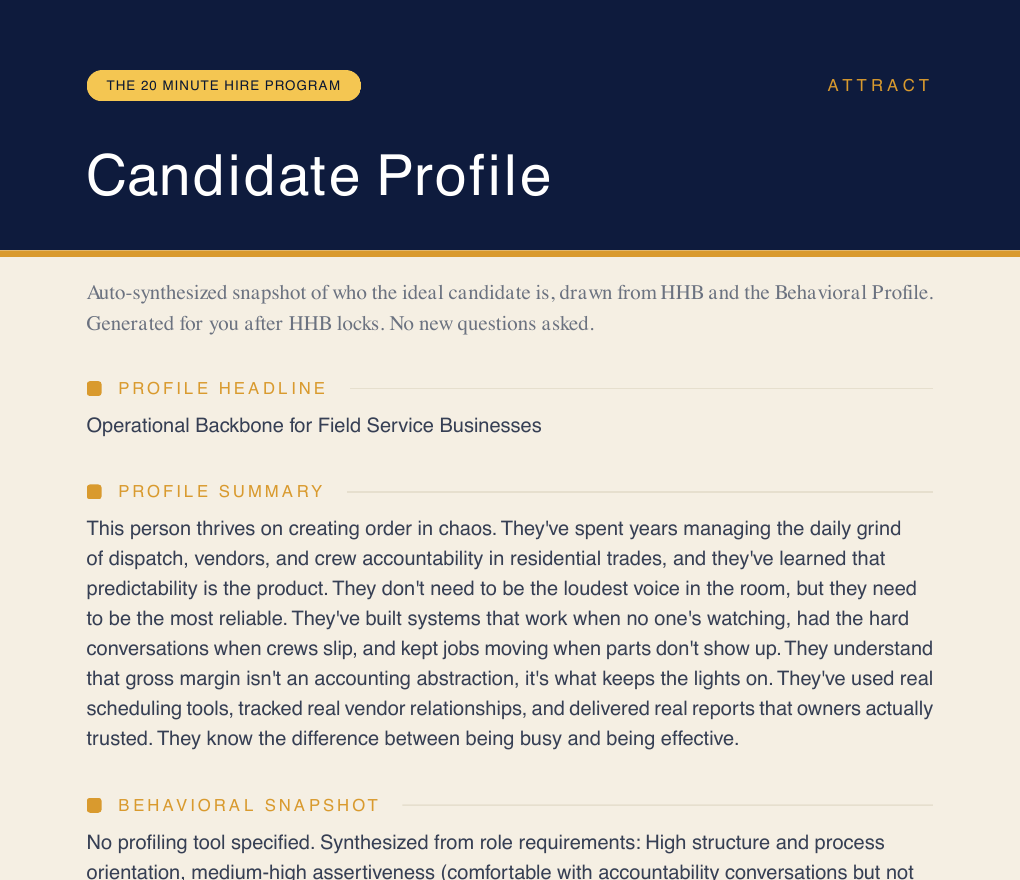
Stop asking "do I like this person?" Start asking "can they do this job, here, now?"
You cannot ask the second question until the job is written down. That is the part you are doing here.
A role in your head
- A job description borrowed off the internet
- Everyone interviewing a slightly different version of the job
- Questions the candidate has already rehearsed
- A new hire left to guess what success means
A role on paper
- The seat defined in writing, including what it is not
- One definition your whole team can read
- Success stated in numbers and dates
- A candidate profile specific enough to recognize
The role.
- What the person has to get done
- What your business is actually like
- What is on your mind about this hire
The role, written.
- Four finished documents
- Yours to keep, edit, and share
- One definition the whole team works from
Three steps, and you are doing two of them.
- You answer questions about the role. Plain ones, the kind you would answer out loud.
- It writes the documents while you go, and shows you each one as it lands.
- You read them, change what is wrong, and keep them.
The twenty minutes is your effort, not a countdown. It waits on you, not the other way around. Stop and come back if you need to.
What changes when the role is finally written down.
"I was hoping to get a good admin assistant. I ended up with a hire of a lifetime. My gut hire helped me move fast. This system helped me hire for scale."Eduardo G., Cafe Azul
"This process helped us understand why we hadn't hired someone after six months of trying. My husband and I were looking for different people and couldn't agree on anyone. It made it crystal clear who we needed, and we found our long-term team member in less than two weeks."Lisa M., Paper Moon Painting
"We had been hiring for the wrong position and had very high turnover. The process helped us understand who we really needed and how to get them. Hiring the right people was a huge step in earning The Best Place to Work award, no doubt."Dr. Bryan Stuckey, Perrin 410 Animal Hospital
"The right people just seem to gravitate to us now. We've been hiring great people, and we have the best team we've ever had."Collin A., Hercules Foundation Repair
The honest questions.
Because the cost of a bad process shows up after everyone is already tired.
Max Kozlovsky has spent 17 years advising owners and leadership teams, in the room with people who had to make payroll, hire fast, and clean up the hire that did not work.
He watched the same pattern repeat hundreds of times: a capable owner, a real need, a gut call, and six months of cleanup. It almost always started in the same place, with a role nobody had ever actually written down.
Start with the role you are trying to fill right now.
Not a hypothetical one. The one that is sitting on your desk. It costs nothing to find out what the job actually is.
Start on the role, free